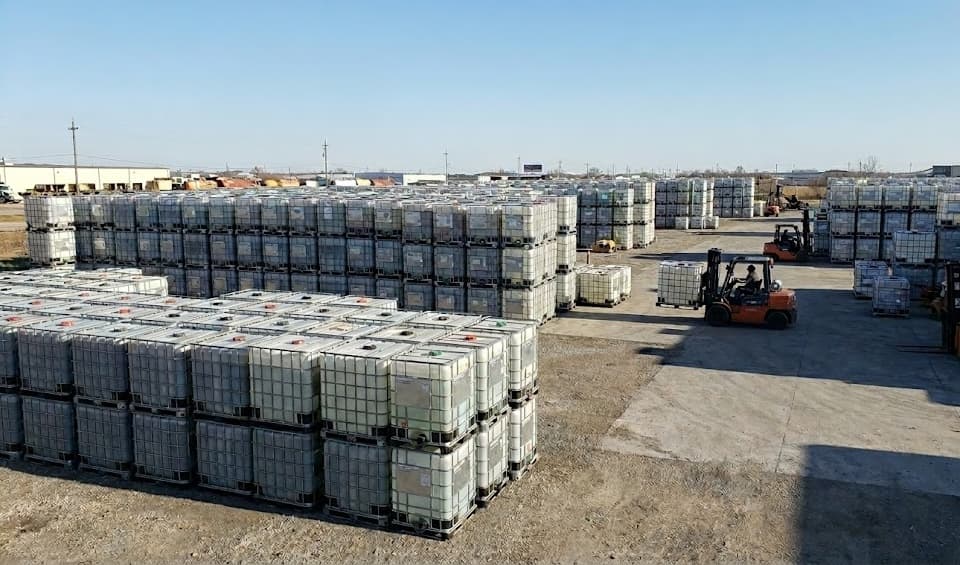
IBCIntermediate Bulk Container. A reusable industrial container designed for bulk liquid and granulated material storage and transport, typically 275-550 gallon capacity.HDPEHigh-Density Polyethylene. The thermoplastic used to blow-mold IBC bottles. Chemically resistant, FDA-approved for food contact, and recyclable.Composite IBCAn IBC consisting of an inner HDPE bottle enclosed in an outer steel or plastic cage, mounted on a pallet. The most common IBC type.ToteCommon industry slang for an IBC tank. "IBC tote" and "tote tank" are used interchangeably with "IBC tank."Butterfly ValveThe quarter-turn valve at the bottom of an IBC tank that controls liquid discharge. Standard size is 2" NPS (National Pipe Straight).Cam-LockA quick-connect coupling system used to attach hoses and adapters to IBC valve outlets. Available in multiple types (A through F) and materials.UN RatingUnited Nations performance certification stamped on IBC tanks. UN 31HA1 indicates a composite IBC approved for transporting hazardous liquids.Packing GroupA classification (I, II, or III) within the UN rating system indicating the degree of hazard. Group I is the most dangerous; Group III is the least.ReconditioningThe process of professionally restoring a used IBC tank to like-new condition through disassembly, cleaning, repair, component replacement, and recertification.Triple RinseA three-stage cleaning protocol: pre-rinse, detergent wash, final rinse. Required for food-grade reconditioning and recommended for most reuse applications.Food GradeA designation indicating that a container meets FDA requirements (21 CFR 177) for direct contact with food products. Applies to the HDPE material and the cleaning process.NPSNational Pipe Straight. The threading standard used on IBC valve outlets in North America. Most common size is 2" NPS.BSPBritish Standard Pipe. The threading standard used on IBC valves in Europe and some international markets. 2" BSP is the equivalent of the American 2" NPS but is not directly interchangeable.S60x6A metric thread standard (60mm diameter, 6mm pitch) used on IBC fill caps and some European valve outlets.Blow MoldingThe manufacturing process used to create HDPE IBC bottles. Molten plastic is inflated into a mold cavity to form the bottle shape.Galvanized SteelCarbon steel coated with a zinc layer to prevent corrosion. Used for IBC cage frames and steel pallets.CageThe tubular steel frame surrounding the HDPE bottle. Provides structural support, impact protection, and enables stacking.PalletThe base platform of an IBC tank. Made from galvanized steel or HDPE. Provides 4-way forklift access and stacking surface.Fill CapThe screw-cap opening on top of the IBC tank used for filling, cleaning, and inspection. Standard sizes are 6" (150mm) and 8" (200mm).EPDMEthylene Propylene Diene Monomer. A synthetic rubber used for valve and lid gaskets. Resistant to water, steam, and many chemicals.Viton (FKM)A fluoroelastomer gasket material with superior chemical resistance. Used in IBC valves handling aggressive chemicals, acids, and solvents.PTFEPolytetrafluoroethylene (Teflon). Used for gaskets and seals in IBC applications requiring maximum chemical resistance and temperature range.DOTDepartment of Transportation. The US federal agency governing the transport of hazardous and non-hazardous materials, including IBC tank regulations (49 CFR 178).CFRCode of Federal Regulations. The codification of US federal regulatory rules. Key IBC regulations include 21 CFR 177 (FDA food contact) and 49 CFR 178 (DOT transport).GMPGood Manufacturing Practice. Quality standards used in pharmaceutical and food manufacturing that affect container selection and documentation requirements.Specific GravityThe density of a liquid relative to water. IBC tanks are typically rated for liquids with a specific gravity up to 1.9 (nearly twice as heavy as water per unit volume).Static LoadThe weight an IBC tank can support when stacked on level ground without movement. Standard rating is 4-high stacking for filled tanks.Dynamic LoadThe weight capacity during transport, which includes vibration and acceleration forces. Typically lower than static load capacity.Cross-ContaminationTransfer of residual substances from a previously used container to its new contents. Prevented by proper cleaning, inspection, and content-history documentation.Certificate of DestructionOfficial document confirming that an IBC tank has been permanently destroyed through an approved process, with material tracking and regulatory compliance.