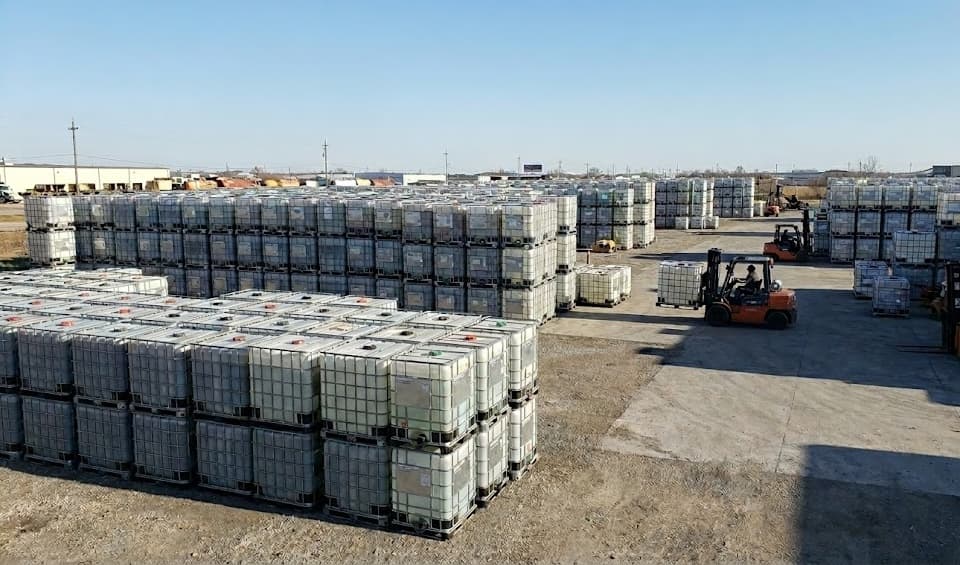
IBC Tank Recycling
When a tank reaches end-of-life, we ensure 100% of its materials find a new purpose. Zero goes to landfill.
Request a Free Quote
How We Recycle IBC Tanks
Our recycling process begins where reconditioning ends. When an IBC tank is too damaged, contaminated, or degraded to be reconditioned for reuse, we disassemble it completely and route every material to the appropriate recycling stream.
Unlike general waste haulers who may landfill mixed loads, we separate every component of every IBC tank. The HDPE bottle is granulated and sold to plastic recyclers. The galvanized steel cage is baled and sent to steel mills. The wooden pallet is chipped for mulch or biomass. Even the small parts — valves, gaskets, labels — are sorted and processed individually.
HDPE Plastic
~59 kg/tankGranulated and sold to pellet manufacturers for reuse in pipes, containers, and lumber alternatives.
Galvanized Steel
~32 kg/tankBaled and delivered to steel mills for melting and recasting into new steel products.
Wood Pallets
~15 kg/tankChipped for landscape mulch, biomass fuel, or rebuilt into new pallets by partner facilities.
Hardware & Valves
~2 kg/tankPolypropylene and metal components sorted and recycled through specialized small-parts processors.
Every Tank Saved Matters
These numbers update in real-time based on our ongoing recycling operations. Every IBC tank we save from the landfill makes a measurable difference.
IBC Tanks Recycled
Tons of Plastic Saved
Gallons of Water Conserved
CO2 Emissions Prevented
Recycling Documentation
For businesses that need to document their waste diversion efforts — whether for regulatory compliance, sustainability reporting, or corporate ESG programs — we provide comprehensive recycling certificates including:
- ✓ Certificate of Recycling with unique tracking ID
- ✓ Material breakdown by weight and type
- ✓ Downstream processor identification
- ✓ Chain of custody documentation
- ✓ Diversion rate calculations for ESG reporting
Before You Recycle
We always check whether a tank can be reconditioned before recycling it. Reconditioning extends the useful life of the container and provides greater environmental benefit than material recycling alone. If your tanks can be saved, we will tell you — and pay you accordingly.
Recycling is our last resort, not our first step. This hierarchy — reuse, recondition, repurpose, recycle — ensures maximum value extraction from every IBC tank.